
1. The Problem
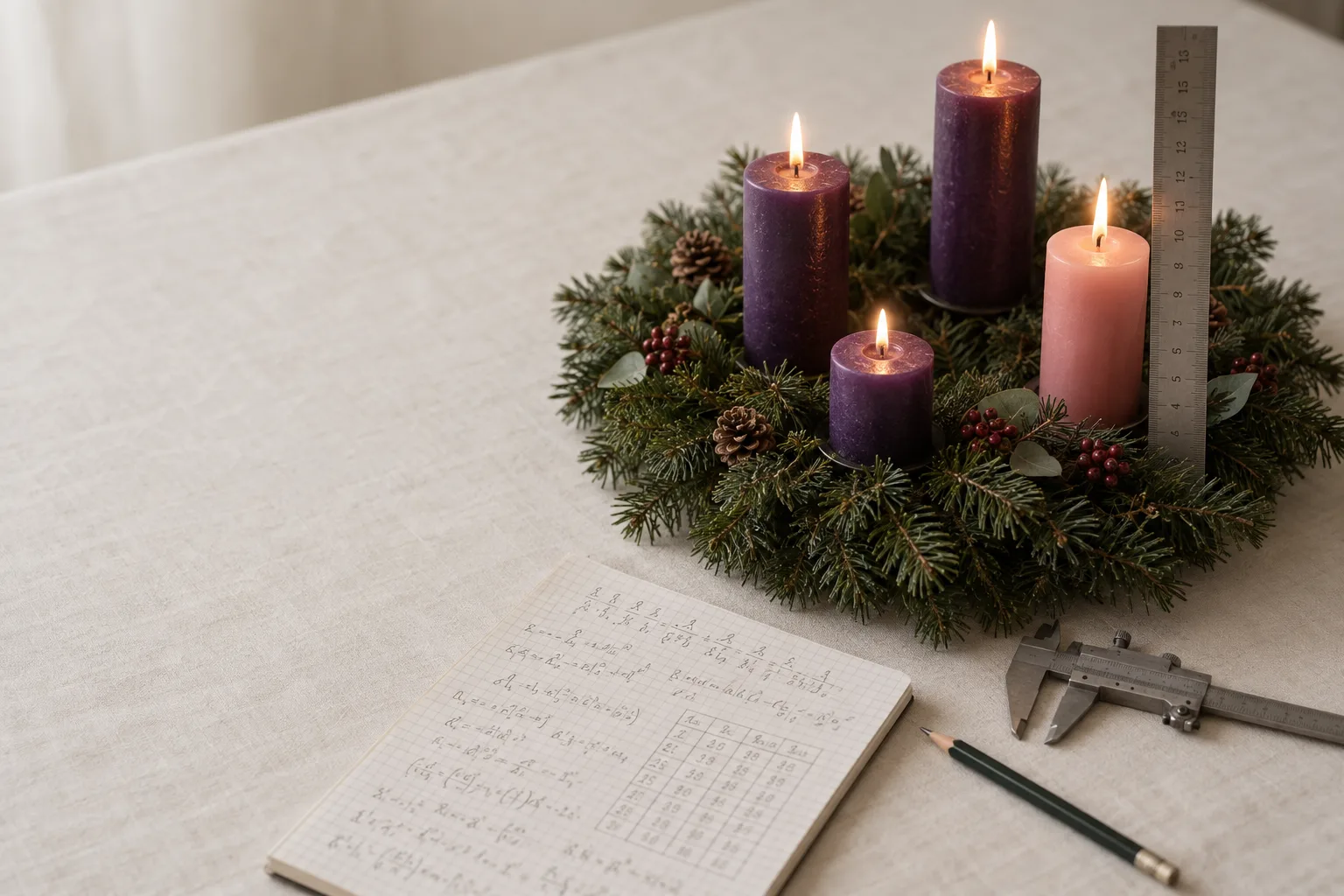
The wreath has four candles. On the first Sunday of Advent one is lit, on the second two, on the third three, and on the fourth all four. Custom suggests relighting the same “old” candle every week and adding a new one. The first candle then burns for four Sundays, the fourth for just one. The difference in height is visible to the naked eye and gives household members legitimate cause for concern.1
We adopt the following assumptions:
- all candles are identical and burn at a constant rate;
- candles burn only on Sundays, and every Sunday lasts equally long;
- on the $k$-th Sunday exactly $k$ candles burn, but which ones is entirely up to us;
- draughts, cats and children with matches are neglected.2
The question is: can the candles be chosen so that on Christmas Eve all four are the same height?
2. Whole Sundays: Impossible
The best achievable is the split $3,3,2,2$: two candles burned one Sunday longer than the other two. Of the $4\cdot 6\cdot 4\cdot 1 = 96$ possible schedules, 48 achieve this result. For example: Sunday I: A; Sunday II: A and B; Sunday III: B, C and D; Sunday IV: all of them. The customary schedule (always add a new candle) gives the split $4,3,2,1$ and is the worst possible.3
3. Sundays in Halves: Possible
In practice this means that halfway through the second Sunday we snuff out A and B and light C and D. Of the $9216$ admissible half-Sunday schedules, $480$ are perfect. Whether the family will accept candles being snuffed out halfway through prayers lies beyond the scope of this paper.
4. The Rose Candle Lemma
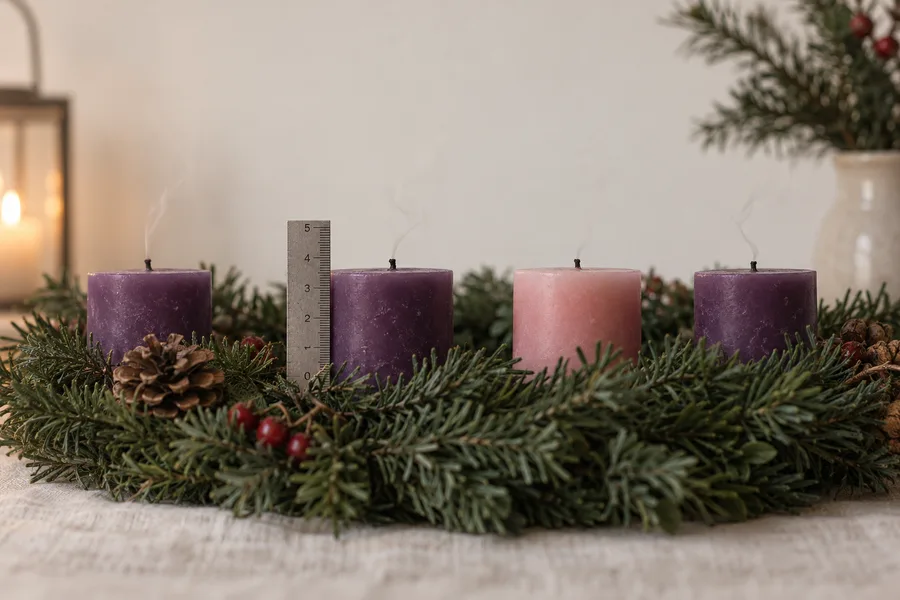
The third Sunday of Advent is Gaudete, the Sunday of rejoicing, when the rose candle is lit for the first time. If we respect this custom, the rose candle may not be lit before the third Sunday.
So what can be done? Without division, the best is again the split $3,3,2,2$, with the rose candle burning for 2 Sundays (15 such schedules out of 27). With halves, the best outcome is $3;\ 2.5;\ 2;\ 2.5$, so the total deviation is half that without division. With a split into thirds, something beautiful happens: the three purple candles burn equally, $2\tfrac{2}{3}$ Sundays each, while the rose one burns only 2.
Pastoral corollary. The rose candle always ends up the tallest. Joy outlasts penance.4
5. Generalisation: a Wreath with $n$ Candles
Consider a wreath with $n$ candles and $n$ Sundays, in which each Sunday is divided into $m$ equal parts, and in each part of the $k$-th Sunday $k$ candles burn.
An amusing fact follows: a wreath with three or five candles could be burned down evenly without splitting any Sundays at all. Four candles are, mathematically speaking, the least convenient choice.5
6. Conclusions
- Without splitting Sundays, burning four candles down evenly is impossible. The best result is $3,3,2,2$.
- With Sundays split into halves it is possible, in 480 ways.
- If the rose candle waits for Gaudete, an even burn-down cannot be achieved by any division of time.
- In the general case it suffices to check whether $m(n+1)$ is even.
A final piece of practical advice: if you care about even candles, light the tallest ones each Sunday. This is precisely the greedy strategy of Theorem 4, and it works even when nobody keeps a chart.
Source materials
References
- J. H. Wichern, the first Advent wreath at the Rauhes Haus, Hamburg 1839 (historical account; according to tradition it had a candle for every day of Advent).
- Universal Norms on the Liturgical Year and the Calendar, 1969, nos. 39–42 (Advent has four Sundays).
- P. G. L. Dirichlet, the pigeonhole principle, 19th century (cited here more out of sentiment than necessity).
Notes
- Personal observation, repeated annually for many years. ↩
- The cat model is left as an open problem. ↩
- Worst in terms of the difference between the longest- and shortest-burning candle. The custom does have other merits, e.g. it requires no chart on the fridge. ↩
- The theological thesis was not subject to peer review. ↩
- We are not proposing any change to tradition. Merely observing. ↩